



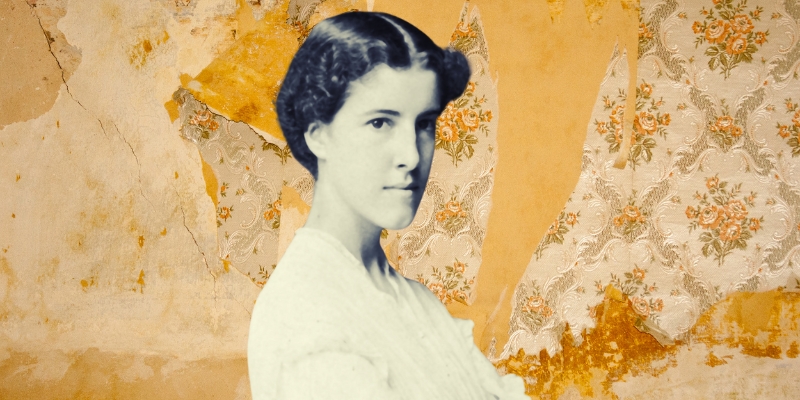
Introspection about the past is important when it comes to important political movements like early Feminism or anti-Patriarchy. History teaches us to avoid the mistakes made in the past and find a new approach.
Look Back to Look Ahead
There’s a new voice in town arguing that women would be “happier” if they abandone their careers and returned to the household, making men the sole breadwinners. They say that such domestic confinement will actually feel natural, fulfilling and more stabilizing for women. But to echo Charlotte Perkins Gilman’s short story The Yellow Wallpaper (1892), enforcing this will be suffocating to women and unfairly treats women as fragile infants, unable to make their own choices. To see that in some places this movement is gaining momentum is dissapointing and we are the cusp of repeating the same mistake again- robbing women of their freedom, well-being and identity.
Gilman’s Warning: The Yellow Wallpaper
Published in 1892 in the New England Magazine, The Yellow Wallpaper is a deeply sensitive portrayal of a woman in isolation who is struggling with mental illness and as a result has been prescribed “rest cure”, something very common in the 19th century. The irony of the whole situation is that the rest cure—enforced on her by her society and husband—in fact drives her to her eventual breakdown. The text offers the reader a window into the perception and treatment of mental illness in the late nineteenth century.
A Haunted House and a Trapped Mind

The Yellow Wallpaper begins with the narrator expressing her hesitation regarding the “colonial mansion” that her husband has rented for the summer. The strange setting of the mansion makes the narrator wonder whether it was a ‘haunted house’. Gilman creates right from the beginning a certain atmosphere: the ghostly dull ambience of a typical gothic tale with its ancient mansions haunted by ghosts, where the inhabitants live in solitude, far away from any other human beings and are locked in by a number of walls, doors, bars and gates. According to Robert D. Hume Gothic is a genre where “conventional madwomen flourish”.
John’s Control and the “Rest Cure”
Her husband, John belittles her concerns and laughs at her; his reaction is considered valid as “this is to be expected in marriage”. As a cure for her nervous depression John has prescribed her ‘rest cure’ forbidding her from doing any work, especially intellectual work, which the narrator finds rather stifling. Being left with no choice and confined to the room as part of her treatment, she turns her attention to the yellow wallpaper. In isolation, she confides her thoughts in a secret journal, well hidden from her husband and his patriarchy.
The Journal as Rebellion
The Yellow Wallpaper, hence is a story compiled upon multiple journal entries that contain various descriptions of the mansion and her developing imagination that she sees someone behind the wallpaper. If the wallpaper traps the narrator’s mind, John confines her physically. This is evident in Jane’s words: “There comes John, and I must put this away,—he hates to have me write a word”. His refusal to acknowledge his wife’s concerns about her own mental state as legitimate, or to listen to her various requests – about their choice of room, receiving visitors, leaving the house, her writing or, of course, the concerns regarding the wallpaper leaves her isolated and trapped, fighting patriarchy and her inner struggles alone.
Slipping Into Madness
She is forced into silence and submission through the rest cure while she desperately needs an intellectual and emotional outlet. She also forces herself to act as though she’s happy and satisfied, to give the illusion that she is recovering, which is worse. She wants to be a good wife, according to the way the role is laid out for her, but struggles to conform especially with so little to actually do. John makes assumptions and assertions such as “You know the place is doing you good”, while the narrator is slowly slipping into madness.
The Wallpaper as Symbol
Soon, the diary becomes a symbol of her rebellion against John’s commands. She wants to be left alone with her thoughts about the yellow wallpaper and John confuses the narrator’s fixation for tranquillity with an improvement in her health, while the narrator is losing her sleep with her obsession with her wild imaginations. Gradually, the yellow wallpaper begins to dominate the story. The wallpaper has her strangely fixated which she describes in vivid details. She first notices a different colored sub-pattern of a figure beneath the “front design.” This figure is eventually seen as a woman who “creeps” and shakes the outer pattern, now seen to the narrator as bars. Slowly, it crystallizes into the image of an imprisoned woman attempting to escape. The mysterious figure of a woman trapped behind the yellow wallpaper becomes a symbol for the ways in which the narrator herself feels trapped by her role in the family.
The Final Breakdown
On the last day of their stay at the mansion, Jane is on a mission to free the imprisoned woman inside the yellow wallpaper. She seemed to be possessed as she went about wildly biting the iron bed and tearing the yellow wallpaper down, crawling on all fours. She has become so dissociated from her sane self to the point that she here refers to herself in the third person, having “become” the ‘woman in the wall.’ The distinction between the two collapses as the ‘woman in the wall’ appears to be a projection of her repressed self.
Surveillance and the Male Gaze
The wallpaper with its “bulbous pattern”, “many heads” can be seen as the watching eyes of John, and even Jennie who has internalized the values as propagated by patriarchal structures of power. In ascribing human qualities to the wallpaper the narrator tells us of the male gaze and surveillance that women find themselves under. It is from these eyes that Jane tried to hide her only source of emotional outlet—her writing. The sickly yellow color of the wallpaper and the foul smell that builds the sickening effect of the enclosed space symbolizes the suffocating repression women have historically faced.
Madness or Resistance?
Towards the end of the climax, Jane is given the trope of the ‘madwoman in the attic. The term ‘madwoman’ is essentially a term used upside down for women nonconforming to existing social patterns or to narrate female resistance.
There is also the interesting connection between the mad narrator of The Yellow Wallpaper and the character of Bertha Mason, the madwoman in the attic in Charlotte Brontë’s Jane Eyre. They both “creep,” or crawl about on all fours. This may be an identification with animal behaviour or a way to explain that both characters have lost touch with civilization or someone who has broken the shackles of patriarchy and is isolated as a wild woman.
Breaking Free, But at a Cost
Both the texts describe isolated conditions that drive women insane, pointing to the psychological effects of the stringent control of women’s behavior and thoughts by the existing patriarchal order. The wallpaper oppresses the narrator until she starts to see herself in it, to identify with it. She becomes the woman in the wallpaper, becomes the wallpaper itself, and then she escapes, barely and deeply traumatized. The lasting image in the story is that of the narrator tearing, crawling and moving over the unconscious body of her husband. It would be perhaps a far-fetched idea to read it as symbolizing an absolutely victorious moment for the female character.
Gilman’s Personal Protest
It is also important to note that the author of The Yellow Wallpaper has written this from a deeply personal space of traumatic experience. It was also her response to Dr. Silas Weir Mitchell, a noted medical practitioner of the time, who prescribed Gilman rest cure as the medical prescription for her mental state of depression. She argues that hysteria and insanity was to be inevitable in an enforced living space without any creativity or change. The ending of The Yellow Wallpaper hence paints a detailed picture of the horror that such a lifestyle brought upon most women in the 19th century.
Lessons for Today
Here lies exposed the lifestyle that the conservatives are supporting and prove to be deadly with the combination of an increasingly capitalistic society where non-earning members will be secondary to the earning male class.